
What Gets Built While You're Deciding
The Architecture Is Already Up

A rocket engineer quit his job, went home to his family’s farm in New Zealand, and built a collar that tells cows where to go using sound and vibration cues. No fences. No farm dogs. No manual herding. He called the algorithm that runs it the Cowgorithm. This week, Peter Thiel’s Founders Fund valued the company at $2 billion, and the deal is reportedly oversubscribed.
And I have to add that many years ago while coaching FIRST LEGO League we had a team work with farmers in another country to create something similar but technology has drastically improved since then.
Simultaneously, Anthropic interviewed 81,000 people across 159 countries about their relationship with AI. The researchers used Claude to conduct the interviews. The most common fear wasn’t job displacement. It was unreliability. And the most consistent finding across the entire dataset: the things people love most about AI are the exact same things they’re afraid of.
Meanwhile, Claude Code can now text you on Telegram when your autonomous task finishes running. Developers call it an OpenClaw killer. The open-source project it replaced had 200,000 GitHub stars. A non-developer dad built his daughter a Guitar Hero-style piano learning app that hit 2.2 million views. And a philosopher in Newcastle-upon-Tyne published an argument that the “stochastic parrots” framing for AI which is the one educators use constantly is doing more harm than good.
What changes about how you lead, teach, or build AI policy if the architecture is already up and the debate about whether to participate is a year behind the room?
This issue is about the gap between the conversation we’re having about AI and the world that’s being built in parallel. That gap is narrowing. And closing it starts with knowing what’s actually being constructed.
1) 81,000 people. One uncomfortable finding.
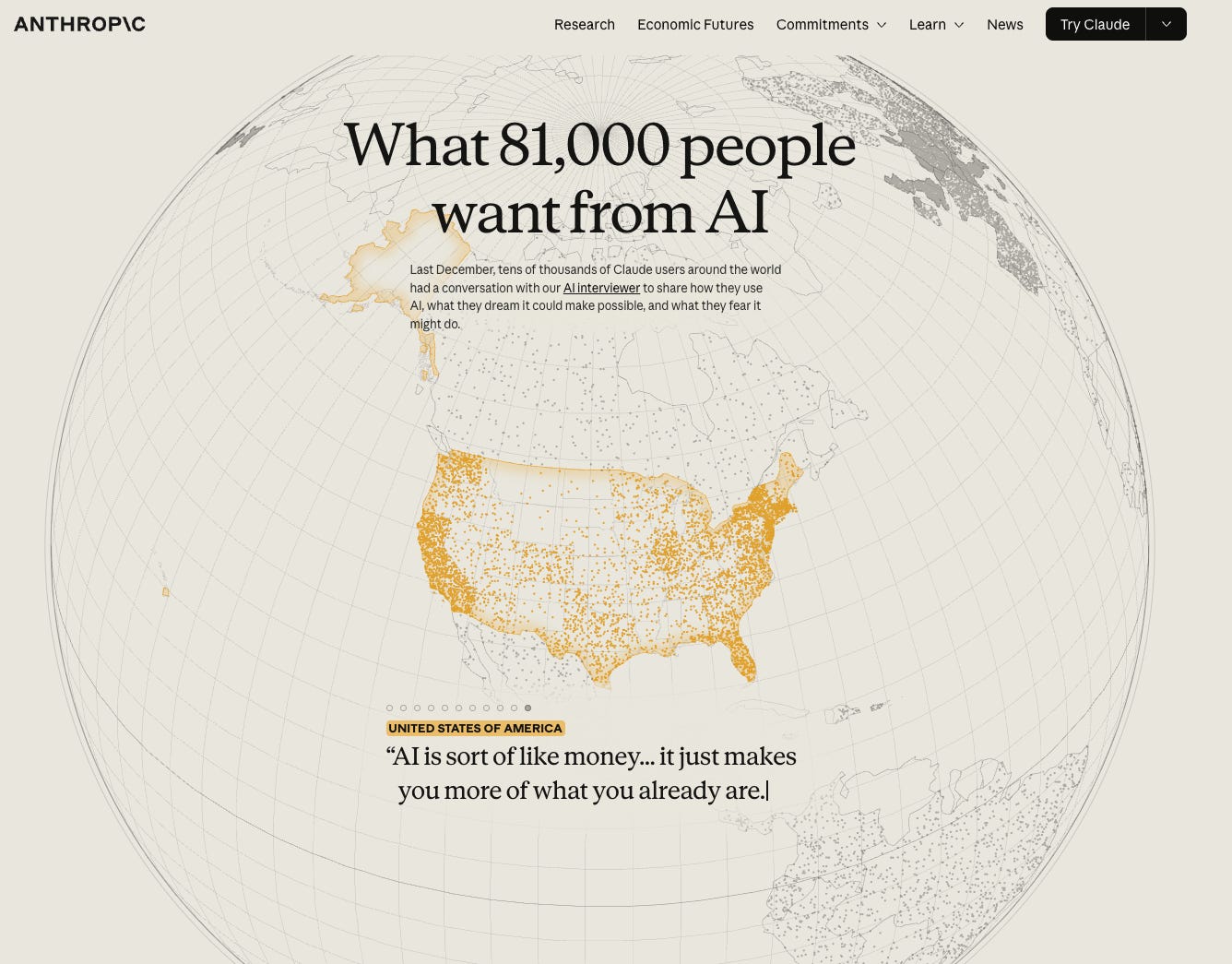
Anthropic just published what they’re calling the largest qualitative study ever conducted on AI use of interviews with 80,508 users across 159 countries in 70 languages, conducted by a version of Claude configured to run open-ended conversational interviews at scale rather than checkbox-based surveys.
Check it out here: Anthropic
The methodology is worth pausing on: AI was the research instrument. Claude interviewed Claude users about Claude.
The top fear was not job displacement or economic inequality. It was unreliability. 26.7% of respondents said they worry most about AI making poor or incorrect decisions, hallucinating facts, or citing sources that don’t exist. Source: Medium
That’s your student population. That’s your parent community. And it’s the finding nobody is leading with in the hype cycle or the panic cycle, because it’s neither dramatic enough for the optimists nor validating enough for the skeptics.
The headline finding which Anthropic named the “light and shade” pattern is the one that should anchor your next community conversation about AI. The things people love most about AI are often the very things they fear. While people may value AI for emotional support, they are also three times more likely to fear becoming dependent on it. Source: Euronews
Benefits and harms don’t cluster in different people. They coexist inside the same person. Across interviews, hope and alarm didn’t divide people into camps, so much as coexist as tensions within each person. Anyone building a community AI policy from a single-sentiment frame as either “this is a tool we should embrace” or “this is a threat we should manage” is missing the actual emotional reality of the people in your building.
One more number for PD coordinators. The largest category of aspiration was professional excellence, cited by 18.8% of respondents, followed by personal transformation at 13.7%, life management at 13.5%, and time freedom at 11.1%. Source: EdTech Innovation Hub
People aren’t asking for AI to do their jobs. They want it to handle the parts that drain them so they can do what actually matters. That’s not a threat frame or an opportunity frame. It’s a human frame. It should be yours too.
Browse: What 81,000 People Want From AI — Anthropic
Personal Tie-in: I continue to share that leveraging AI is not the online hype of saving time but looking at our workflows to determine efficieny pain points and effectiveness pain points.
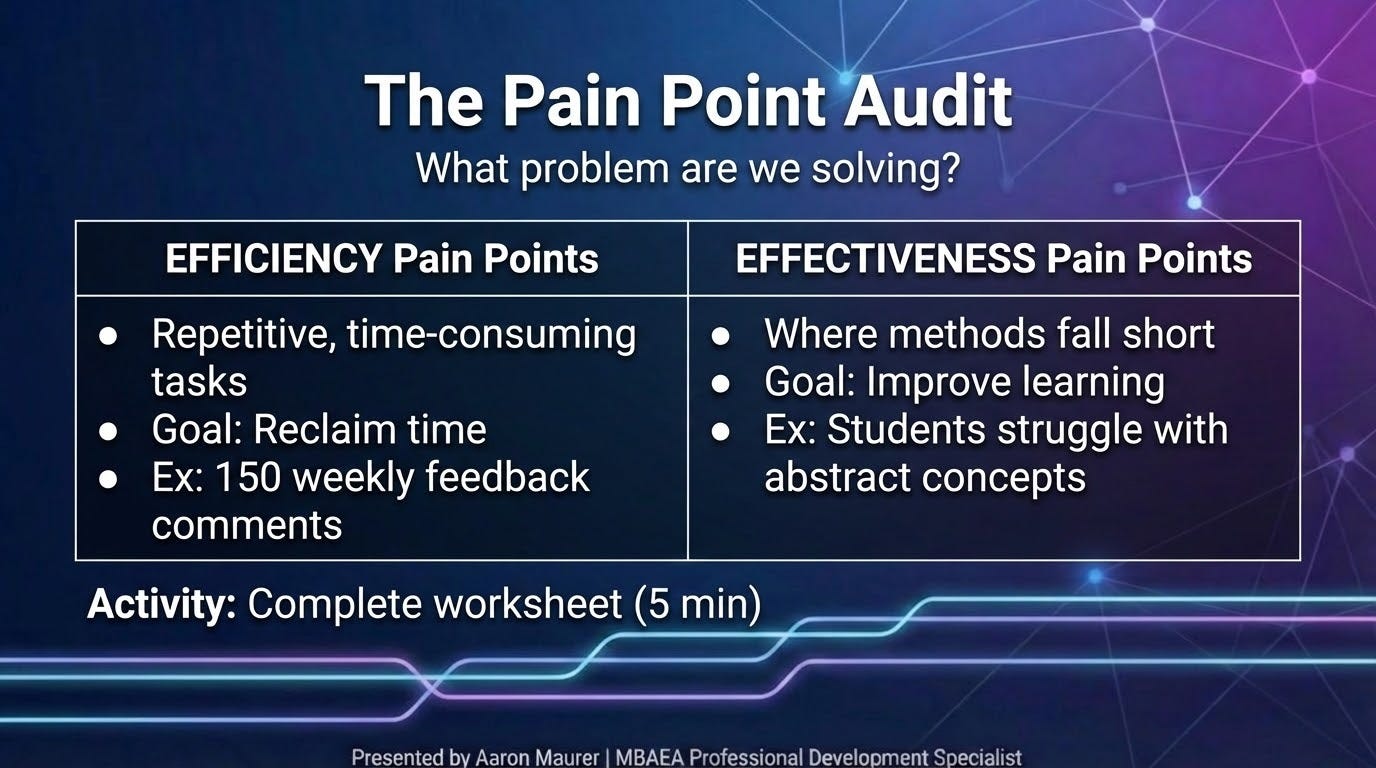
So What? People aren’t divided into AI optimists and AI pessimists. They’re both at once. Your policy process needs to hold that tension, not resolve it too fast.
Try This: Before your next AI conversation with staff or community members, ask this question: “What’s one thing you’re glad AI can do, and one thing about that same capability that makes you uncomfortable?” Let both answers exist in the room at the same time.
2) The wrong debate and the blocks within reach
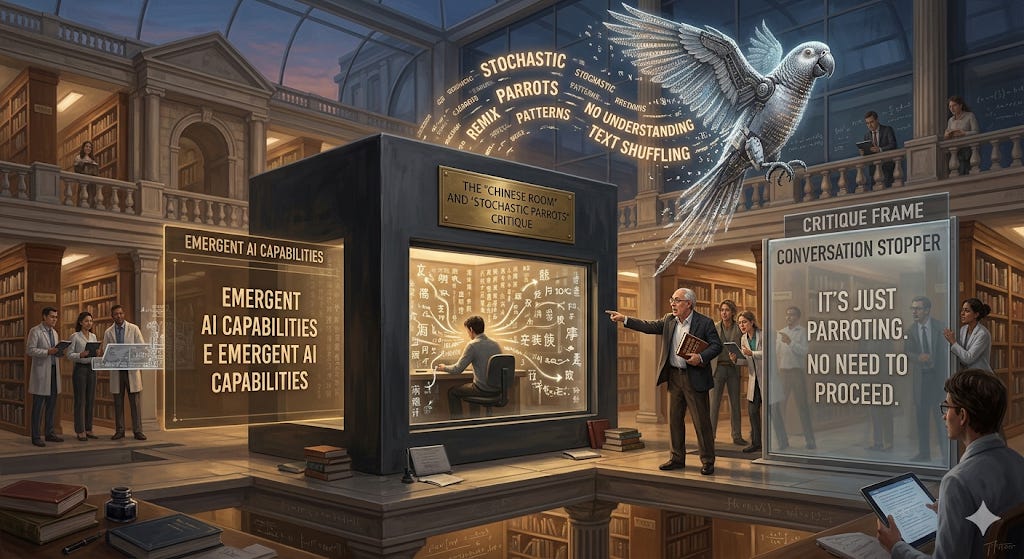
There’s a paper that’s been doing heavy lifting in every AI skepticism conversation for five years. Emily Bender, Timnit Gebru, and co-authors argued that large language models remix text patterns without genuine understanding as the “stochastic parrots” critique. It traces back to John Searle’s Chinese Room: a black box that shuffles symbols without knowing what they mean. It’s intellectually serious. It’s also, increasingly, a frame that’s hardening into a conversation-stopper rather than an opening.
Pete Wolfendale, a philosopher based in Newcastle, pushes back on that framing in a way that doesn’t sound like tech optimism. He doesn’t claim LLMs understand the way humans do. He argues that the binary of “real understanding” versus “meaningless text generation” misses something important about how meaning actually works including in humans. His point: most of what humans communicate meaningfully about isn’t grounded in direct first-person experience either. We talk about black holes, stock markets, historical events, cancer diagnoses because we’re embedded in language communities that carry that meaning. If socially-distributed grounding counts as “real” for humans, the question of whether LLMs carry some of that grounding becomes harder to close off cleanly. His framing: LLMs are “in the game, even if they’re not strictly playing it.” We can ask them for reasons. We can have their outputs reshape what we think. That partial participation is what matters.
I’ve been chewing on this as I have used this stochastic parrots description and connecting dots that alongside Angela Stockman’s opening line in her latest piece about writing and meaning-making: “Before Amari reached for the blocks, someone put blocks within reach.” She’s writing about physical makerspaces for young writers and about the interdependent design decisions a teacher makes before any child arrives. She draws on Reggio-inspired practice, which treats the environment itself as a third teacher: a space that communicates values, invites inquiry, and makes thinking visible. And she invokes architect Simon Nicholson’s loose parts theory and the argument that the degree of inventiveness in any environment is directly proportional to the number and kinds of variables it contains: the parts that can be moved, combined, redesigned, and taken apart.
The AI governance equivalent maps exactly. Every AI-powered system is an environment. It communicates values whether or not anyone made those values explicit. It invites certain kinds of inquiry and forecloses others. The degree of genuine human judgment in any AI-shaped learning environment is proportional to how many parameters remain movable, how many loose parts exist, by the people inside it. A fully fixed system produces fixed behavior. A system with genuine variability produces genuine agency. The question isn’t whether your AI platforms are teaching something. They are. The question is whether you know what they’re teaching and whether you designed it to be that.
Browse: Material, Mode, Message, Meaning — Angela Stockman Browse: In Defence of Stochastic Parrots (sort of) by Pete Wolfendale / Deontologistics(the newsletter that I read that made me come back to this paper)
So What? The debate about whether AI “really” understands is eating the time you need for the more urgent question: what understanding are you designing the environment to support?
Try This: Replace “Does AI understand what it’s saying?” with “What does this AI-generated output make it easier or harder for my students to think?” Run one lesson this week with that question in your head.
3) Context is the product
Ruben Hassid’s guide to Claude Cowork is the most useful non-technical argument for “stop prompting, start building” that I’ve read in a while. And it maps directly to what knowledge workers in K-12 need to hear.
The shift he names: ChatGPT trained you to write longer, better prompts. Cowork inverts that. The game is text files. Take everything you know from your writing style, your company’s rules, your best examples, your past work and put it in text files. Drop them in a folder. Point Claude to that folder. The more context you give it as files, the less prompting you need. The output goes from generic AI to this actually sounds like a full-time employee. Source: Substack
His folder architecture (About Me / Projects / Templates / Claude Outputs) is essentially an onboarding document for a smart colleague who needs to learn your job. You set Global Instructions once. They run every time.
The feature worth slowing down on: AskUserQuestion. When you add this to your prompt, Cowork generates an interactive form of actual buttons, clickable options, multi-select choices, rankings you can drag and reorder. AI is finally prompting you. That inversion of a tool as interviewer, human as the one being made to think clearly should sound familiar to anyone who has designed good facilitation. The parallel isn’t incidental. The quality of what comes out is a direct function of how precisely you articulate what you actually need going in.
And now, the tool doesn’t even need you at the terminal. Claude Code Channels lets users send messages to a running Claude Code session via Telegram or Discord and have it message them back when a task is finished. Previously, Claude Code users were stuck interacting with the agentic harness on the Claude desktop application, terminal or supported developer environment. That’s changing. Source: VentureBeat
The architectural distinction is “push, not pull.” Traditional interaction: you sit at the terminal, type a prompt, Claude responds. Channels interaction: Claude Code runs in the background. Events arrive from the outside world. Claude processes each one with full project context. Your presence at the terminal is optional. The tool is becoming a persistent partner, not a session you open and close. Source: DEV Community
Browse: Cowork — Ruben Hassid
Browse: Cowork Dispatch — Artificial Corner
Read: Claude Code Channels Documentation — Anthropic
Personal Tie-in: I am going to spend time this weekend building out my own folder so will report soon. As of now, I am fine tuning my AI running and fitness coach and dashboard and cannot wait to share very very soon.
So What? The quality gap between AI outputs that sound generic and outputs that sound like you is almost entirely a context problem, not a model problem.
Try This: Write a 150-word professional context file today: who you are, how you actually communicate, one piece of work you’re proud of. Save it as about-me.md. Paste it at the start of your next Claude conversation before you type anything else. Note what’s different.
4) The Cowgorithm question

A farmer opens an app, taps a button, and cattle across three countries start walking toward the milking station on their own. No farm dogs, fences, or physical labor. Just a solar-powered GPS collar sending sound and vibration cues to each animal. Halter trademarked this system as the Cowgorithm. Blockonomi
Halter is in talks to raise a new funding round led by Peter Thiel’s Founders Fund that would double its valuation to more than $2 billion. The deal is reportedly oversubscribed. Yahoo Finance
The collars connect to a farmer’s phone, allowing ranchers to monitor their herd’s location and health indicators through an app and even move cattle remotely using vibrations and audio cues from the devices. It’s a step beyond the typical livestock monitoring collar. Halter’s pitch: full herd management from a smartphone, at $5 to $8 per animal per month.
Here’s why this is in a K-12 newsletter. The national conversation about AI is focused almost entirely on productivity of office work, knowledge work, writing and coding. Halter’s approach is part of a broader “precision agriculture” push, where farmers use technology to better manage their fields and reduce human labor needs. AI is showing up in pastures, surgical suites, supply chains, and livestock monitoring at scale not because the governance conversations caught up, but because the value propositions did. The Alpha School story from the Feb 27 Hard Fork episode showed what happens when AI gets deployed on students at scale without sufficient governance. The Halter story isn’t scary becuasuse it’s a business success. But what it illustrates is the pattern: the algorithm encodes behavior before the policy catches up. That pattern is coming to student-facing tools. The cowgorithm question for school leaders isn’t “how do we feel about AI?” It’s “who designed the behavioral algorithm that’s now shaping what our students do in our buildings?”
Browse: Halter — Precision Agriculture AI
So What? AI’s most consequential deployments aren’t happening in chatbots. They’re happening in systems that shape behavior at scale, invisibly, before anyone asked the governance question.
Try This: Name one AI system in your district that influences behavior without the people being influenced knowing it’s there. Attendance monitoring, reading level routing, scheduling optimization……it doesn’t have to be dramatic. Just name it.
5) Vibe-building and the floor that dropped
A non-developer dad built his daughter a piano learning app. Guitar Hero-style, AI-powered, custom-built for how she learns. The video hit 2.2 million views.
That’s the story. That’s also the policy question nobody has asked yet.
When the floor for building drops to “dad with no coding background builds custom educational software for his kid in a weekend,” what does that mean for the educational technology procurement model your district has been running for twenty years? What does it mean for the teacher who wants a student-facing tool that fits their classroom exactly, not the closest approximation in the app store? And what does it mean for the K-12 governance question: who is authorized to build tools that students interact with?
This isn’t a rhetorical alarm. It’s a design question. The teacher who builds a targeted intervention app for their class using Cowork or Claude Code isn’t a threat to your district. They might be your best AI integration story of the year. The question is whether your structures treat them as a resource or a liability.
Personal Tie-in: Have you seen a teacher build something for students using AI? Or a student build something? Even a prototype. What happened when it hit the district structure? I am putting finishing touches on a AI Design Challenge for students in a local school district and am interested to see what they develop and how that shapes my thinking.
So What? The accessibility of building is now ahead of the accessibility of understanding what you’re building and why.
Try This: Ask three teachers this week: “If you could build one small tool that would make your job 20% easier, what would it do?” Don’t tell them it’s possible. Just listen for what’s actually in the way.
ON MY RADAR
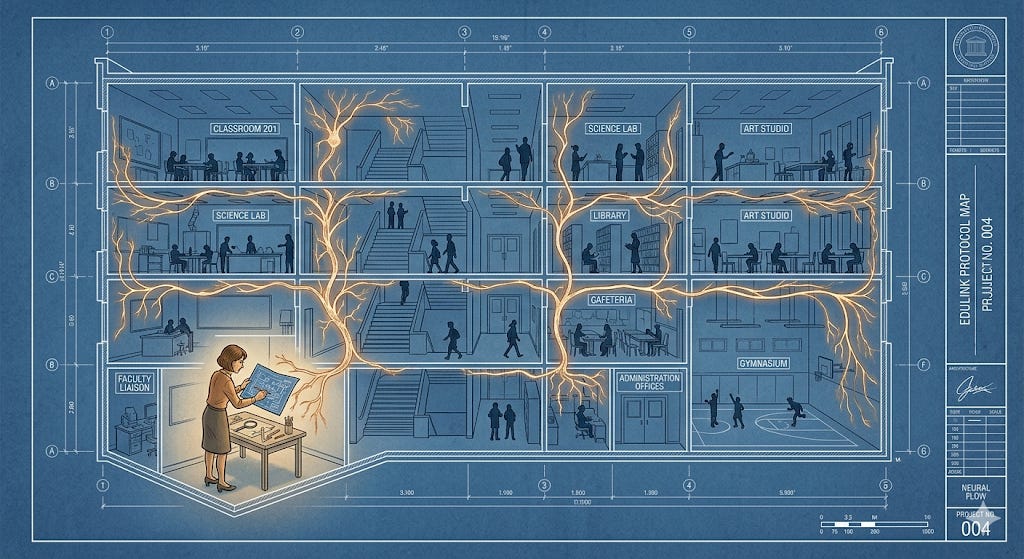
AI Creep Is Real — Mike Kentz — The same researcher who gave us the 25-study synthesis turns his attention to how AI expands into more of your work week without a deliberate decision to let it in. Worth the read before you design your next PD around AI integration.
10 Ways to Use AI in K-12 Data Analysis — AJ Juliani — Practical, standards-adjacent, and built for the instructional leaders who are still running reports manually.
Interactive Explainers: ChatGPT vs Claude — WhyTryAI — A side-by-side for people still figuring out which tool for which job. Good to hand to a department head who is just starting.
They Copied a Fly’s Brain Into a Computer — Diamant AI — Outside the ed-policy lane but a genuinely mind-bending piece for any biology class or Philosophy of Mind conversation.
Alexa+ Gets an Adults-Only Mode — Amazon added a personality option to Alexa+ that curses, roasts, and drops sarcasm on command. Requires extra security checks, disables with Amazon Kids active. Mention it to your digital citizenship people. It’s coming up in households this spring.
Claude Skills viral essay — Written by a Claude Code team member, praised by its creator, 5M views. If your teachers are starting to build with Claude Code, this is the “read this first.”
ONE SMALL HUMAN THING
Before Amari reached for the blocks, someone put blocks within reach.
Before the algorithm ran, someone decided what the algorithm was optimizing for.
Before the meaning was made, someone arranged the materials.
CLOSING REFLECTION
If the architecture is already up and the debate about whether to participate is a year behind what are you actually deciding, and what have you already decided without deciding?
— A-A-Ron